Modern emission control systems rely heavily on structural foundations to facilitate crucial catalytic reactions. At the heart of these complex systems sits the ceramic catalyst substrate, quietly enabling environmental compliance. Automotive engineers face a continuous, difficult challenge today. You must maximize catalytic efficiency to meet highly strict Euro 7 and EPA standards. Simultaneously, you must minimize engine backpressure and prevent rapid thermal degradation under extreme conditions. Balancing these opposing forces requires deep technical insight.
This article provides a concrete evaluation framework for automotive and industrial system engineers. We will guide you through specifying and sourcing the optimal design for your specific applications. You will discover how to balance operational reliability, geometric constraints, and material properties effectively. Ultimately, you will learn to specify robust designs without ever sacrificing long-term performance.
Key Takeaways
Substrate cell design requires a calculated trade-off between Geometric Surface Area (GSA) for emission conversion and Open Frontal Area (OFA) for backpressure management.
Cell density (CPSI) and wall thickness must be evaluated alongside the specific washcoat characteristics to prevent channel plugging and ensure long-term durability.
Material selection (typically Cordierite or Silicon Carbide) dictates thermal shock resistance and Coefficient of Thermal Expansion (CTE), directly impacting lifespan under high-temperature cycling.
Vendor selection should hinge on demonstrated precision in extrusion forming tolerances, scalability, and adherence to automotive quality standards (IATF 16949).
Aligning Substrate Design with Compliance and Performance Goals
Engineering a modern emission system demands a precise balance. You must carefully bridge the gap between strict regulatory compliance and optimal engine fuel economy. Defining success criteria early in the development phase is absolutely essential. The chosen ceramic exhaust substrate must handle massive gas volumes while supporting active precious metals. If the internal structure restricts exhaust flow, overall vehicle performance will suffer.
Aggressive emission targets naturally require higher chemical conversion rates. To achieve these rates, engineers often specify denser cellular networks. These networks increase the surface area available for catalytic reactions. However, this approach introduces a severe conversion versus backpressure trade-off. Poorly designed substrates drastically increase exhaust backpressure. The engine must then work harder to push exhaust gases out of the tailpipe.
This increased pumping work causes a direct "fuel penalty." The vehicle consumes more fuel simply to overcome the physical restriction in the exhaust line. Overcoming this hurdle requires meticulous geometric planning. System engineers must specify architectures balancing open pathways and coated walls. You must optimize the gas flow dynamics to prevent unwanted pressure drops. We highly recommend mapping out these pressure constraints before approving any initial substrate prototype.
Evaluating Geometric Parameters: CPSI and Wall Thickness
The geometric layout of a substrate fundamentally dictates its performance limits. You must evaluate these physical dimensions closely during the design phase.
Cells Per Square Inch (CPSI)
The standard metric for cell density is Cells Per Square Inch (CPSI). Different applications require vastly different density ranges. For standard light-duty gasoline vehicles, engineers typically specify between 400 and 900 CPSI. These higher densities provide massive surface area for rapid gas conversion. Conversely, heavy-duty diesel applications usually operate between 200 and 300 CPSI. Lower density prevents excessive soot from rapidly plugging the channel pathways.
Higher CPSI directly increases the Geometric Surface Area (GSA). Higher GSA allows more precious metal washcoat to interact with the passing exhaust gas. However, higher density also demands significantly thinner walls. You must thin the walls to maintain an acceptable Open Frontal Area (OFA). If OFA drops too low, backpressure spikes immediately. This delicate geometry requires precise manufacturing capabilities to execute correctly.
Wall Thickness Considerations (mil)
Modern manufacturing has shifted heavily toward ultra-thin wall architectures. Today, a high-quality ceramic catalyst substrate often features walls measuring just 2 to 3 mil in thickness. Thinner walls drastically reduce the overall thermal mass of the converter core. Lower thermal mass allows the substrate to heat up much faster after a cold engine start. This rapid heat-up significantly improves catalyst light-off times, cutting cold-start emissions.
However, you must acknowledge a major risk factor here. Thinner walls inherently reduce the isostatic strength of the ceramic body. They reduce mechanical durability during both the canning process and long-term vehicle operation. Fragile walls can easily fracture under extreme vibration or sudden mechanical shock. System engineers must carefully evaluate these structural trade-offs. You need a design strong enough to survive assembly but thin enough to light off quickly.
Cell Shape Dynamics
Engineers must also consider the specific cross-sectional shape of the individual cells. Common designs include square, hexagonal, and highly specialized asymmetrical cell structures.
Square Cells: The industry standard. They are easy to manufacture and offer good baseline flow. However, acute 90-degree angles often lead to unwanted washcoat pooling in the corners.
Hexagonal Cells: These provide wider interior angles. Wider angles reduce washcoat pooling significantly. They also distribute mechanical stress more evenly across the matrix.
Asymmetrical Cells: These designs enlarge the inlet channels while shrinking the outlet channels. They provide excellent ash storage capacity for heavy-duty filter applications.
Table 1: Common Geometric Specifications by Application
| Application Type | Typical CPSI Range | Standard Wall Thickness | Primary Objective |
| Light-Duty Gasoline | 400 - 900 | 2 mil - 4 mil | Rapid light-off, high conversion |
| Heavy-Duty Diesel | 200 - 300 | 5 mil - 8 mil | Soot management, low backpressure |
| High-Performance Sports | 200 - 400 | 3 mil - 5 mil | Maximum exhaust flow rates |
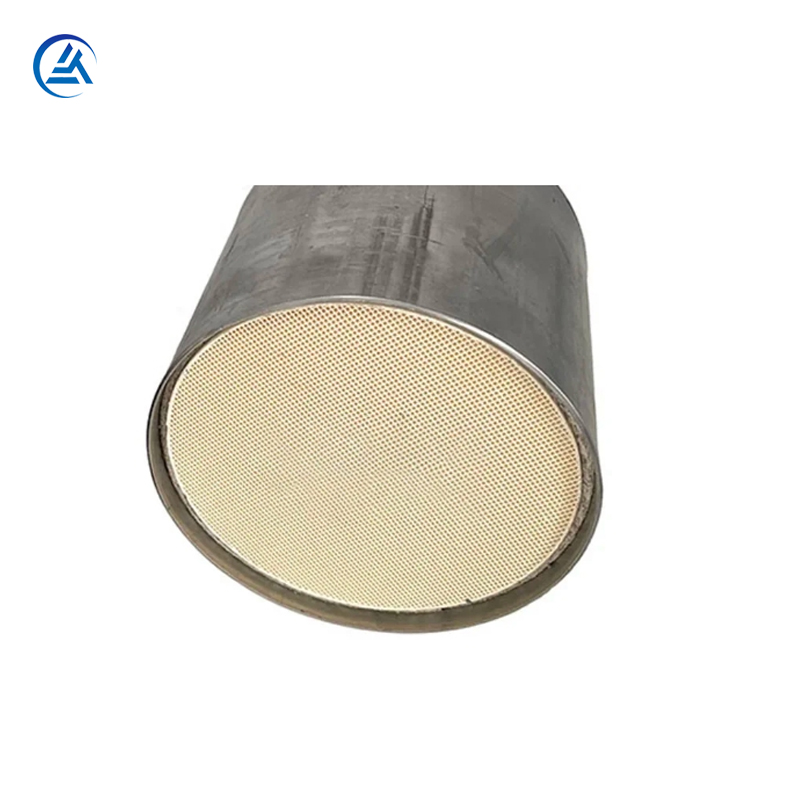
Thermal Shock Resistance and Material Selection
The harsh operating environment inside an exhaust system demands exceptional material stability. Substrates endure extreme, rapid temperature fluctuations daily. Therefore, selecting the correct base material is a critical engineering decision.
Material Baselines
The industry currently relies on two primary ceramic materials. Cordierite serves as the undisputed industry standard for most standard catalytic converters. It dominates the passenger vehicle market globally. Conversely, engineers utilize Silicon Carbide (SiC) primarily for heavy-duty Diesel Particulate Filters (DPFs). SiC handles the extreme, localized heat generated by high-soot combustion much better than Cordierite.
SiC boasts significantly higher thermal conductivity. It transfers heat away from localized hotspots efficiently. However, SiC is also heavier and more expensive to manufacture. Cordierite offers a highly cost-effective, lightweight alternative for applications lacking massive soot accumulation.
Coefficient of Thermal Expansion (CTE)
When evaluating a honeycomb ceramic carrier, the Coefficient of Thermal Expansion is a non-negotiable metric. CTE measures how much a material expands as it heats up. Cordierite possesses an exceptionally low CTE. This unique property prevents the substrate from cracking during rapid heat-up and cool-down cycles.
When you start a cold engine, the center of the substrate heats up instantly. The outer edges remain relatively cold. This severe thermal gradient causes massive internal stress. High CTE materials would literally tear themselves apart under these forces. A low CTE guarantees structural integrity over thousands of driving cycles.
Operating Temperature Thresholds
Continuous operating temperatures dictate the required material grade completely. Standard gasoline engines often generate continuous exhaust temperatures around 400°C to 800°C. Cordierite handles these continuous thresholds effortlessly. However, active regeneration events present a different challenge.
During an active DPF regeneration, trapped soot burns off violently. These peak exothermic events can push localized temperatures well beyond 1000°C in mere seconds. If your application involves heavy soot loading and frequent forced regenerations, SiC becomes mandatory. You must map out your expected peak thermal events before finalizing your material selection.
Chart: Material Comparison Parameters
| Parameter | Cordierite | Silicon Carbide (SiC) |
| Thermal Conductivity | Low | High |
| Coefficient of Thermal Expansion | Extremely Low | Moderate |
| Weight / Density | Lightweight | Heavy |
| Manufacturing Cost | Lower | Higher |
Washcoat Compatibility and Extrusion Tolerances
Even the best structural design fails if it cannot hold the active catalyst securely. You must ensure perfect harmony between the bare ceramic structure and the chemical washcoat.
Washcoat Adhesion
Catalytic washcoat takes the form of a viscous liquid slurry. Manufacturers pump this slurry through the bare substrate channels. The washcoat must adhere firmly to the channel walls. It cannot flake off under high exhaust gas velocity. To achieve strong adhesion, you must match the substrate's internal micro-porosity to the slurry's specific rheology.
Engineers measure pore volume and pore size distribution carefully. If the pores are too small, the slurry cannot anchor itself into the ceramic wall. If the pores are too large, the slurry sinks entirely into the wall structure. This restricts internal gas flow and wastes expensive precious metals. Perfect washcoat adhesion ensures durability without restricting essential gas flow dynamics.
Extrusion Forming Realities
Manufacturing these intricate honeycombs requires highly advanced extrusion technology. The wet ceramic clay passes through an incredibly complex steel die. This process carries inherent manufacturing risks. Common risks include channel warping, micro-cracking, and uneven wall thickness. These defects often emerge during the subsequent high-temperature firing process.
Buyers must audit potential suppliers relentlessly. You should demand strict evaluation metrics. Focus heavily on their specific defect rates and dimensional tolerance consistency. Consistency across large batch production separates premium manufacturers from average ones. Uneven walls create weak points, leading to catastrophic failure in the field.
Canning and Packaging Compatibility
The substrate never operates naked; it sits wrapped tightly inside a metal shell. The canning process uses an intumescent support mat to grip the ceramic body. You must pay close attention to the substrate's outer skin thickness.
If the outer dimensions lack precision, the matting cannot apply uniform pressure. Uneven pressure causes exhaust gas to bypass the catalyst entirely. Even worse, localized pressure spikes can easily fracture the substrate under standard engine vibration. Dimensional tolerance directly controls packaging success.
Verify the supplier's outside diameter (OD) tolerance capabilities.
Ensure outer skin thickness remains uniform across the entire cylinder length.
Test the interaction between the chosen matting material and the ceramic skin surface.
Conduct physical vibration testing on the fully canned assembly.
Shortlisting Logic and Procurement Next Steps
Sourcing a Ceramic Catalyst Substrate requires more than just checking a specification sheet. You must validate real-world performance through rigorous testing protocols. Moving from theoretical design to volume production requires a strict shortlisting logic.
Prototyping and Validation Testing
Never commit to high-volume production without exhaustive prototype testing. You should require all shortlisted suppliers to provide comprehensive flow bench testing data. This data proves their design meets your specific Open Frontal Area targets.
Furthermore, demand extensive thermal cycling results. The prototype must survive hundreds of extreme temperature swings without micro-cracking. You also need accurate pressure drop mapping across various exhaust flow rates. Real-world validation testing highlights hidden structural flaws before they ruin your production launch.
Quality Assurance Standards
Automotive supply chains operate on flawless consistency. You must verify supplier compliance with rigorous international quality standards. ISO 9001 serves as a basic entry requirement. However, true automotive suppliers must hold active IATF 16949 certification. This standard guarantees strict process controls and continuous improvement protocols.
During the audit, ask suppliers for historical statistical data. Specifically, request their data on isostatic crush strength consistency. A capable supplier can prove their crushing strength rarely deviates across thousands of production batches. Consistent strength ensures smooth canning operations.
Supply Chain Scalability
Finally, assess the manufacturer’s overall capacity to scale their operations. Ramping up volume often exposes hidden production weaknesses. Can the supplier scale their extrusion lines rapidly? They must increase volume without compromising the crucial micro-structural integrity of the ceramic body. A robust supply chain guarantees steady production regardless of market fluctuations.
Conclusion
Specifying a modern catalytic core is never a simple, one-size-fits-all commodity purchase. It remains a highly integrated, complex engineering decision. Every geometric parameter affects subsequent performance metrics directly. The best design always optimizes the delicate balance between Geometric Surface Area, Open Frontal Area, thermal durability, and realistic manufacturability.
System engineers must evaluate materials, cell densities, and micro-porosity cohesively. Missing just one parameter can lead to severe mechanical failures or regulatory non-compliance. Therefore, you must establish strict evaluation criteria early in the design cycle.
We recommend taking immediate, concrete action. Initiate pilot testing programs with a small, vetted shortlist of top-tier manufacturers. Seek out partners capable of transparently sharing their internal extrusion tolerance data. Demand clear material CTE specifications up front. Rigorous upfront validation testing guarantees long-term success in the field.
FAQ
Q: What is the optimal CPSI for a ceramic catalyst substrate?
A: The optimal CPSI depends entirely on the specific application. Standard passenger gasoline vehicles typically require 400 to 600 CPSI to maximize surface area for rapid gas conversion. Heavy-duty diesel applications usually utilize much lower densities, around 200 to 300 CPSI. Lower density prevents excessive soot accumulation from plugging the channels.
Q: How does wall thickness impact catalytic converter performance?
A: Wall thickness dictates thermal mass and structural strength. Thinner walls (2-3 mil) lower the thermal mass drastically. This allows for faster light-off times and reduces overall exhaust backpressure. However, these thin walls naturally compromise the mechanical isostatic crush strength, making the unit more fragile during the canning assembly process.
Q: Why is cordierite the most common material for honeycomb ceramic carriers?
A: Cordierite dominates the industry due to its exceptionally low Coefficient of Thermal Expansion (CTE). This unique thermal property makes it highly resistant to severe thermal shock. It prevents the ceramic matrix from cracking during rapid heat-up and cool-down cycles. It also offers excellent durability at a highly cost-effective price point.
Q: How do I test the quality of a ceramic exhaust substrate before purchasing?
A: You must demand comprehensive validation testing from the supplier. Key evaluations include testing isostatic crush strength and verifying dimensional tolerance accuracy. You should also review extensive thermal cycling test data. Finally, always verify the internal pore size distribution to ensure perfect compatibility with your chosen chemical washcoat slurry.


