Selecting the correct honeycomb catalyst is a critical engineering decision. It directly impacts emission compliance, backpressure management, and long-term operational stability. Engineers and procurement teams often face conflicting claims in the market. You must constantly weigh thermal efficiency against mechanical durability. Making the wrong choice can lead to premature system failure or excessive exhaust restrictions.
We designed this guide to provide an evidence-based breakdown of both material types. It isolates the technical realities of ceramic and metal substrates. We separate marketing hype from physical performance data. You will learn how to match the right substrate to your specific operational environment. By understanding the core material differences, you can finalize your specification confidently and ensure reliable emission control.
Key Takeaways
Thermal vs. Structural: Ceramic substrates offer superior thermal retention and cost-efficiency for stable environments, while metal substrates provide lower backpressure and high vibration resistance for extreme conditions.
Backpressure Impact: Metal substrates allow for thinner cell walls, typically resulting in a 20–30% reduction in exhaust backpressure compared to standard ceramics.
Lifecycle Value: Total Cost of Ownership (TCO) must account for initial capital expenditure, operational lifespan, and the recovery value of Platinum Group Metals (PGMs) during recycling.
1. Defining the Baseline: The Role of the Honeycomb Catalyst
Every emission control system relies on a structural backbone. The core function of any honeycomb catalyst is maximizing active surface area for gas-solid reactions. It must achieve this while minimizing exhaust flow resistance. When noxious gases enter the catalytic converter, they must physically contact the active Platinum Group Metals (PGMs). The honeycomb structure forces the gas through hundreds of tiny parallel channels, guaranteeing high contact rates.
Cell density plays a major role in meeting strict industrial and vehicular emission standards. We measure this density in Cells Per Square Inch (CPSI). Higher CPSI means more surface area and better conversion efficiency. However, pushing the CPSI too high restricts gas flow. Finding the optimal balance between conversion rates and engine backpressure is essential.
The market primarily bifurcates into two distinct material categories. You will typically choose between ceramic (specifically cordierite) and metallic (Fe-Cr-Al alloy) substrates. Ceramic materials rely on extrusion processes to form their shape. Metal substrates use thin corrugated foils wound tightly together. Each material reacts differently to heat, pressure, and physical shock.
2. Ceramic Honeycomb Catalysts: High Efficiency in Stable Environments
The traditional ceramic honeycomb catalyst remains the industry standard for standard passenger vehicles and stationary applications. Manufacturers build these primarily from extruded cordierite. Cordierite is a magnesium iron aluminum cyclosilicate known for excellent thermal mass and remarkably low thermal expansion.
We see several primary advantages when deploying ceramic substrates. First, the manufacturing process is highly cost-effective and scalable. Extruding cordierite allows for rapid, high-volume production. Second, ceramic holds heat exceptionally well. This provides rapid catalyst light-off times in steady-state operations. Quick light-off is crucial because most emissions occur during the first few minutes of a cold start. Finally, raw cordierite boasts high natural porosity. This microscopic roughness allows for excellent washcoat adhesion, ensuring the active precious metals stay bonded to the channel walls.
However, implementation carries specific risks. Ceramic materials struggle under rapid, extreme temperature spikes. This susceptibility to thermal shock can cause internal cracking if exhaust temperatures fluctuate too violently. Furthermore, inherent brittleness makes them highly vulnerable in high-vibration applications. You should avoid standard ceramics in heavy-duty off-highway equipment where physical impact is common.
Best Practice: Always implement flexible mounting mats when installing ceramic substrates into metal housings. This compensates for the different thermal expansion rates between the ceramic core and the steel shell.
3. Metal Honeycomb Catalysts: Durability Under Extreme Stress
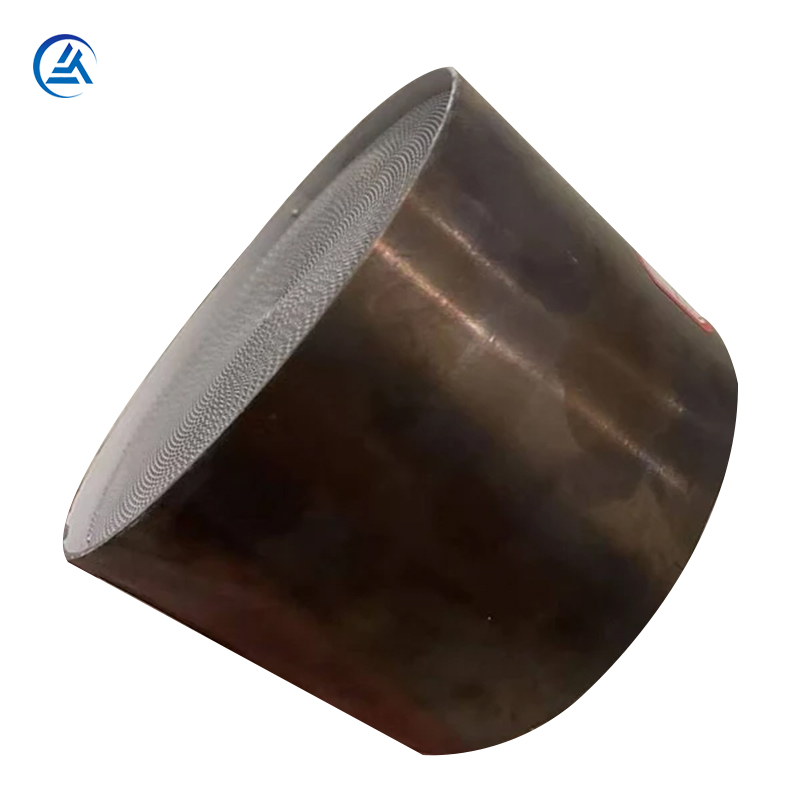
When physical demands exceed ceramic limits, engineers turn to the metal honeycomb catalyst. Manufacturers construct these from ultra-thin corrugated metallic foils. These foils typically consist of iron-chromium-aluminum (Fe-Cr-Al) alloys. The layers are tightly wound and vacuum-brazed together to form an unbreakable monolithic block.
The primary advantage lies in the physical geometry of the cell walls. Metal foils are incredibly strong. This allows engineers to design ultra-thin wall structures. You can achieve much higher CPSI counts without increasing exhaust backpressure. Additionally, they offer superior mechanical strength against severe vibrations and direct physical impact. Metal will deform under stress, whereas ceramic will shatter. Metal also possesses high thermal conductivity. It transfers heat quickly, preventing localized melting or "hot spots" during high-load engine operations.
Deploying metal substrates requires addressing a few implementation realities. The complex winding and brazing process demands higher upfront capital expenditure. Additionally, metal foil has a very smooth surface compared to porous cordierite. This lower natural porosity requires specialized, advanced washcoat technologies. Manufacturers must apply a chemical primer layer to ensure the PGM washcoat adheres permanently to the smooth metal channels.
Common Mistake: Applying a standard ceramic washcoat formulation directly to a metal substrate. The washcoat will quickly flake off under high exhaust flow, ruining emission compliance.
4. Head-to-Head Evaluation: Ceramic vs Metal Catalyst Substrate
Selecting the right material requires comparing specific operational parameters. We break down the performance across four critical engineering categories below.
Heat Resistance & Thermal Shock
Ceramic holds a distinct advantage in heat retention. It insulates the exhaust gas, keeping internal temperatures consistently high for optimal chemical conversion. However, it remains highly vulnerable to rapid thermal cycling. Sudden drops or spikes in exhaust temperature can fracture the core. Metal tolerates rapid temperature fluctuations easily. It conducts heat away from the core efficiently, which protects the system from catastrophic meltdown during engine misfires.
Flow Dynamics and Pressure Drop
Metal catalyst substrates predictably outperform ceramics in flow dynamics. Ceramic walls typically measure around 0.10mm to 0.15mm in thickness. Metal foils commonly reach 0.04mm to 0.05mm. Thinner walls create a larger open frontal area. This directly improves engine efficiency by significantly reducing the pressure drop across the converter. High-performance engines rely heavily on this improved flow.
Durability and Vibration (Heavy-Duty Focus)
Evaluating substrate survivability is critical for high-impact scenarios. Heavy-duty commercial vehicles and industrial gas turbines generate immense vibration frequencies. Ceramic brittle fractures happen frequently under sustained heavy shock. The brazed joints of a metal core absorb and distribute mechanical stress. Metal remains the undisputed choice for survivability in severe environments.
Cost-to-Performance Ratio
Engineers must balance initial procurement scope against extended operational lifecycles. A ceramic core offers a lower initial unit cost, making it highly attractive for standard applications. Conversely, metal demands higher initial production effort. You must weigh the lower initial cost of ceramic against the extended physical lifespan and flow benefits a metal counterpart delivers over years of harsh operation.
Material Comparison Overview
| Performance Feature | Ceramic Substrate | Metal Substrate |
| Wall Thickness | 0.10mm - 0.15mm (Thicker) | 0.04mm - 0.05mm (Thinner) |
| Backpressure | Moderate to High | Low (High Flow) |
| Vibration Resistance | Low (Brittle) | Excellent |
| Thermal Shock Tolerance | Poor | Excellent |
5. Industry-Specific Deployment & Sizing Logic
Different industries present unique atmospheric and physical challenges. You cannot apply a one-size-fits-all approach when specifying a substrate.
Heavy-Duty & Off-Road Vehicles: Agriculture, mining, and long-haul trucking generate punishing vibration. The metal catalyst substrate is increasingly the default here. Rough terrain and constant engine shudder will quickly destroy standard ceramics. Metal ensures the emission system outlasts the chassis.
Stationary Industrial Emissions (VOC/NOx removal): Chemical plants and continuous-operation facilities feature completely stable environments. They have virtually zero mechanical vibration. Because these systems are massive, weight is rarely a concern. Therefore, the ceramic catalyst substrate dominates. It provides exceptional thermal stability for continuous, steady-state VOC destruction at massive scales.
Consumer Hearth & Wood Stoves: Residential wood stoves deal with low exhaust flow and high soot production. They need high heat retention to burn off particulates. Ceramic is the standard here. It balances initial material costs with the strict compliance standards required for residential environments.
6. Total Cost of Ownership (TCO) & End-of-Life Recycling
Understanding the full lifecycle requires looking past the initial installation day. Lifespan expectations vary heavily based on application severity. You must calculate replacement frequency by assessing the operating environment. A poorly spec'd core will fail early, disrupting operations entirely.
Lifespan Expectations: In a perfectly stable industrial environment, a ceramic core can last indefinitely without physical trauma. However, place that same core on an excavator, and its lifespan drops drastically due to mechanical fatigue.
Maintenance Considerations: You must account for the realities of cleaning and substrate fouling. Both materials face poisoning from engine oil additives, sulfur, or lead. Ash buildup blocks channels over time. High-pressure cleaning can safely clear a metal core, but the same pressure might crack a brittle ceramic matrix.
Recycling Value (PGM Recovery): End-of-life processing physically differs between the two materials. Extracting Platinum (Pt), Palladium (Pd), and Rhodium (Rh) is a complex metallurgical process. Metals melt differently than ceramics during smelting. Ceramic substrates turn into slag, allowing refiners to easily separate the precious metals. Metal substrates require distinct chemical leaching or specialized smelting because the Fe-Cr-Al alloy interacts differently in the furnace. This physical extraction difficulty directly impacts the final material yield recovered.
Conclusion
Making the right material selection ensures your system runs efficiently while meeting stringent environmental targets.
The Shortlisting Logic: Choose ceramic for stationary, stable applications where weight and vibration are non-issues. It provides excellent heat retention and proven reliability for steady environments.
The High-Performance Choice: Choose metal for space-constrained, high-vibration, or performance-critical applications. It excels where you demand minimal pressure drop and maximum physical survivability.
Next Steps: Review your specific space constraints, backpressure limits, and vibration metrics. We advise consulting with an application engineer to evaluate your exact exhaust flow data before finalizing your procurement.
FAQ
Q: Can you replace a ceramic catalyst substrate with a metal one?
A: Yes, you can replace a ceramic core with a metal one. However, you must account for physical fitment, as metal cores often require different housing dimensions. Because metal significantly reduces backpressure, you may also need to recalibrate your engine control unit (ECU) and downstream oxygen sensors to prevent warning lights.
Q: Which substrate type provides a lower pressure drop?
A: Metal substrates provide a noticeably lower pressure drop. Their metallic foils allow for ultra-thin cell walls. This creates a much larger open frontal area compared to thicker ceramic walls, directly reducing exhaust flow resistance and improving overall engine breathing.
Q: Do metal honeycomb catalysts require different washcoats than ceramic ones?
A: Yes. Ceramic is naturally porous, allowing standard washcoats to grip the surface easily. Metal foil is extremely smooth. To prevent the active materials from flaking off under high exhaust velocity, manufacturers must apply specialized chemical primer layers to ensure proper washcoat adhesion on metal.
Q: Are ceramic honeycomb catalysts more difficult to recycle?
A: Actually, standard ceramic is generally easier for refiners to process. During the smelting process, cordierite melts into a predictable slag, allowing Platinum Group Metals (PGMs) to separate easily. Metal substrates require distinct processing methods, as the metallic carrier alloy can complicate the extraction and refining yields of the precious metals.


