Seeing the dreaded "Drivetrain malfunction" warning on your iDrive screen immediately ruins your drive. When accompanied by limp mode, failed emissions tests, or OBD codes like 480A and 481A, your diesel vehicle is signaling a critical exhaust blockage. Dealerships often quote exorbitant prices for replacing this essential emissions component, leaving many owners deeply frustrated. You cannot simply ignore these warnings, as doing so risks severe turbocharger damage and compromised engine performance.
We built this objective, technical framework to help you navigate your replacement options effectively. You will learn how to select a replacement dpf for bmw 5 series that balances original equipment reliability with sensible pricing. Our guide reveals the hidden pitfalls of sub-standard aftermarket units and empowers you to make a mechanically sound decision. By understanding substrate materials and fitment logic, you can protect your engine and pass your next emissions inspection.
Key Takeaways
Replacement vs. Cleaning: While soot can be regenerated, compacted ash accumulation is permanent; at 120k–150k miles, replacement is often the only mathematically sound choice.
Material Matters: An OEM quality soot filter relies on Silicon Carbide (SiC) and proper precious metal washcoats, unlike budget Cordierite alternatives that melt under high EGTs.
Compliance: Fitting a fully compliant EURO 6 DPF is non-negotiable for modern F10/G30 chassis to pass stringent MOT/emissions inspections and prevent ECU rejection.
System Reset: Installing a new DPF requires professional software (e.g., ISTA/INPA) to register the filter change and reset backpressure adaptations.
Diagnosing the BMW 5 Series DPF: When is Replacement Unavoidable?
Understanding exactly what happens inside your exhaust system prevents costly misdiagnoses. Diesel owners frequently confuse soot buildup with ash accumulation. They require entirely different solutions. Soot is unburnt carbon fuel. It remains burnable. Your engine periodically raises exhaust gas temperatures to incinerate this soot during active or passive regeneration. Ash represents something entirely different. It is an incombustible byproduct left behind by burnt engine oil and metallic lubricant additives. Over thousands of miles, this ash permanently clogs the microscopic channels within the filter block.
Many specialized services advertise comprehensive chemical cleaning procedures. They claim off-car ultrasonic bathing will restore your factory unit to brand-new condition. Acknowledge the limits of this approach. Ultrasonic cleaning can temporarily restore exhaust flow by clearing out loose soot and surface debris. However, it rarely returns the filter to OE backpressure specifications if the core suffers from thermal degradation. Once the internal walls warp or crack from repeated high-temperature regeneration cycles, no amount of chemical flushing will fix the structural damage.
Best Practice: Always perform a thorough pre-purchase diagnostic routine before condemning the filter. We highly recommend completing the following checklist to verify upstream engine health.
Check the main coolant thermostat. If it fails open, the engine never reaches the required 88°C operating temperature, preventing regeneration.
Test all glow plugs and the glow plug control module. Modern diesel engines utilize glow plugs to raise cylinder temperatures during active regeneration.
Inspect the EGR valve for leaks or sticking mechanisms. A faulty EGR introduces excessive soot into the exhaust stream, rapidly overwhelming the filter.
Verify the integrity of the boost hoses. Boost leaks cause the engine to run excessively rich, generating massive amounts of particulate matter.
Replacing the filter without fixing an upstream thermostat or EGR fault guarantees your new unit will clog within a few weeks.
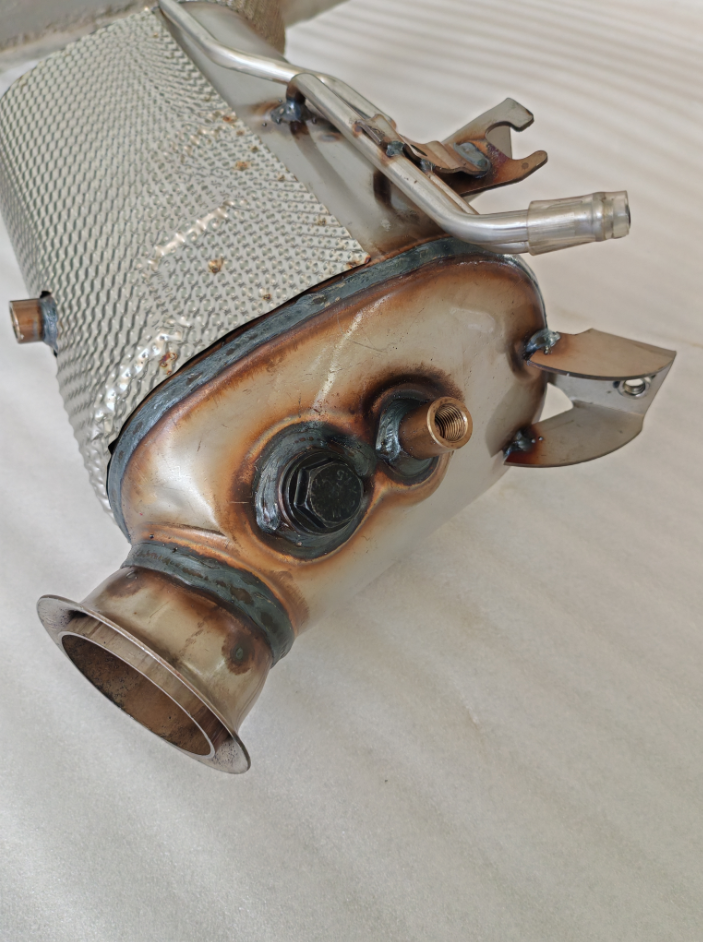
Anatomy of an OEM Quality Soot Filter
Material science dictates how well your exhaust system performs under stress. High-end replacements always utilize Silicon Carbide (SiC) for their core substrate. This material boasts an exceptionally high melting point and superior thermal shock resistance. High-torque diesel engines generate massive exhaust gas temperatures during heavy acceleration and active regeneration. Silicon Carbide easily handles these extreme thermal cycles, making it a truly durable particulate filter. Conversely, budget aftermarket units rely on Cordierite. While cheaper to manufacture, Cordierite melts and collapses far easier under high heat, leading to catastrophic exhaust blockages.
Substrate Material Comparison Chart
| Material Type | Thermal Shock Resistance | Melting Point | Suitability for BMW Diesels |
| Silicon Carbide (SiC) | Excellent | ~2,730°C | Highly Recommended (OEM Standard) |
| Cordierite | Poor to Average | ~1,200°C | Not Recommended (High risk of melting) |
The substrate alone cannot do the job. The precious metal washcoat plays an equally vital role. Platinum and palladium coat the internal honeycomb structure. High-grade units use factory-level loading of these precious metals to catalyze passive regeneration at lower exhaust gas temperatures. When you drive on the highway, the heavy metal washcoat allows the filter to burn off soot naturally without forcing the engine management system into a fuel-heavy active regeneration cycle.
External construction matters just as much as internal chemistry. Emphasize casing and weld integrity when evaluating options. Look for units manufactured from 409 or 304-grade stainless steel. Factories employing robotic TIG welding processes produce vastly superior joints. Poorly welded casings inevitably develop exhaust leaks. Furthermore, cheap sensor boss threads frequently strip during installation, turning a simple sensor swap into a mechanical nightmare.
Cross-Referencing Fitment & EURO 6 DPF Compliance
Proper fitment requires precise attention to chassis codes and engine variations. BMW iterates its exhaust architecture frequently, meaning a part from one generation rarely fits the next. You must understand your specific vehicle iteration.
E60 (M57 engines): These represent older technology. They generally follow Euro 4 or early Euro 5 emissions standards. The exhaust layouts are simpler, but age makes sensor removal difficult.
F10/F11 (N47/B47/N57 engines): These vehicles currently sit squarely in the most common failure window. They require strict Euro 5 or Euro 6 compliance. The ECU monitoring on these models is highly sensitive to incorrect backpressure readings.
G30 (B47/B57 engines): These modern platforms utilize highly advanced SCR (Selective Catalytic Reduction) and particulate integrated modules. They demand exact factory specifications to function properly.
Never rely on generic "universal fit" drop-down menus on automotive websites. You must match your specific VIN to Genuine BMW part numbers. Cross-referencing components directly to OE numbers like 18308512287 ensures you receive the correct flange angles and sensor port locations. Even a slight variation in pipe curvature makes installation physically impossible.
Common Mistake: Many owners consider a "DPF delete" to solve their issues permanently. We strongly advise against this. Deleting emissions equipment carries severe legal and technical risks. It results in immediate MOT or local emissions inspection failures. Furthermore, modifying emissions hardware frequently invalidates your vehicle insurance policy in many jurisdictions. Installing a certified EURO 6 DPF keeps your vehicle road-legal, protects the environment, and prevents complex ECU programming headaches.
Evaluating Cost: Genuine BMW vs. Premium Aftermarket
Navigating the price discrepancy between dealership parts and internet alternatives feels overwhelming. Dealerships routinely quote $2,500 or more for this repair. Genuine parts carry a premium for valid reasons. They encompass massive research and development costs, dealership markups, and comprehensive warranties. They guarantee perfect fitment and precise precious metal loading. However, this price tag often exceeds the practical budget of a second or third owner.
Conversely, the internet overflows with budget options priced between $300 and $500. Expose this false economy immediately. Manufacturers hit these low price points by drastically reducing the precious metal washcoat and using cheap Cordierite cores. Reduced precious metals force your engine into frequent active regenerations. This burns excessive fuel, dramatically lowers your fuel economy, and rapidly degrades engine oil. These budget filters routinely suffer premature failure within 10,000 miles, placing you right back where you started.
You need to define the pragmatic middle ground. A premium aftermarket choice provides a sensible solution. You should mandate strict criteria before purchasing. Look for direct-fit designs requiring no cutting or welding. Demand an OE-matched core density to ensure correct backpressure. Verify the manufacturer offers a minimum 2-year warranty. Finally, seek out suppliers who do not impose frustrating core charge hassles. By adhering to these standards, you secure an OEM quality soot filter without absorbing the massive dealership markup.
Installation Realities: Protecting Your New Investment
Physical installation represents only half the battle. You must protect your newly purchased hardware by addressing the surrounding ecosystem. We strongly recommend replacing the exhaust pressure sensor (EPS) and the exhaust gas temperature (EGT) sensors concurrently. These sensors live in a brutally hot, soot-filled environment. Over time, their readings drift and become biased. An old, inaccurate pressure sensor will tell the ECU the exhaust is blocked even when it is completely clear. This false data will force continuous regeneration cycles, rapidly melting your new investment.
The ECU reset remains the most crucial step of the entire process. Failing to inform the engine control unit that a fresh unit is installed guarantees disaster. When a filter slowly clogs over 100,000 miles, the ECU continuously adapts its backpressure models to keep the engine running smoothly. If you bolt on a clean exhaust component without resetting these adaptations using professional diagnostic software (such as ISTA or INPA), the car applies the old, clogged-filter logic. It will incorrectly fuel the engine and rapidly clog the newly installed BMW 5 series DPF within a few hundred miles.
After successfully bolting the hardware and completing the software reset, execute a proper break-in drive. Take the vehicle on an uninterrupted highway drive for at least 45 minutes at speeds exceeding 50 mph. This sustained driving allows the engine management system to calibrate the fresh sensors. The ECU uses this time to log baseline differential pressures across the clean substrate, establishing a healthy starting point for future regeneration calculations.
Conclusion
Replacing this emissions component is a significant but highly predictable maintenance milestone for high-mileage diesel owners.
Never base your purchasing decision purely on the bottom-line price; inferior materials will cost you double in the long run.
Prioritize Silicon Carbide substrate quality, exact OE number matching, and strict Euro 6 compliance to ensure longevity.
Always pair physical hardware replacement with proper diagnostic software resets and sensor renewals.
Take action today to restore your vehicle's performance and fuel efficiency. Enter your exact VIN or model year into a specialized fitment tool to view validated, original-equipment-grade replacement options tailored perfectly for your specific chassis.
FAQ
Q: How long should a new DPF last on a BMW 520d/530d?
A: A high-quality replacement should last between 100,000 and 150,000 miles. Achieving this lifespan requires regular motorway driving to facilitate passive regeneration. You must also maintain healthy upstream engine components, specifically the EGR valve, thermostats, and glow plugs, to prevent excessive soot production.
Q: Can I just clear the DPF warning light and keep driving?
A: No. Clearing the dashboard light merely hides the symptom without fixing the physical blockage. Continuous driving in limp mode drastically increases exhaust backpressure. This extreme pressure will eventually blow your turbocharger oil seals, leading to catastrophic engine failure and vastly higher repair bills.
Q: Do your replacement DPFs require core returns?
A: Most premium aftermarket retailers eliminate core charges to remove friction from the buying process. You typically receive the new unit outright without needing to package and ship your heavy, soot-filled original unit back to the warehouse, saving you time and return shipping costs.
Q: Will an aftermarket DPF void my BMW warranty?
A: No. Under the Magnuson-Moss Warranty Act (in the US) or local block exemption laws (in the UK/EU), installing an aftermarket replacement cannot void your vehicle warranty, provided the replacement part meets or exceeds factory specifications and conforms to strict OEM-quality standards.


