Have you ever noticed how restrictive factory exhaust components choke engine performance? Car enthusiasts and custom builders constantly battle this frustrating bottleneck hidden beneath their vehicle floorboards. Standard catalytic converters prioritize extreme emissions padding over efficient exhaust scavenging.
This creates a major problem for driving dynamics. When a stock unit eventually fails, buyers face exorbitant costs for OEM direct-fit replacements. Standard designs restrict exhaust flow significantly, leaving valuable horsepower trapped inside the engine. They also drastically dull the natural exhaust note.
You will discover how switching to a high-flow upgrade balances exhaust velocity, deepens acoustic tones, and saves money. We will explore crucial material choices, necessary fabrication realities, and strict compliance boundaries. This guide equips you to choose the perfect component for your next custom exhaust project.
Key Takeaways
Performance Reality: High-flow cats (typically 200-cell) significantly reduce exhaust backpressure compared to stock (400–600 cell), but require engine tuning to realize maximum horsepower gains.
Acoustic Shift: Upgrading alters the exhaust note, generally providing a deeper, more aggressive tone while reducing in-cabin drone.
Material Matters: Choosing between a high flow ceramic converter and a metallic core dictates thermal threshold and longevity.
Installation Caveat: "Universal" means fabrication (cutting and welding) is mandatory; they are not plug-and-play bolt-on solutions.
Compliance Check: Emissions legality (EPA vs. CARB) varies by state and dictates which converter can be legally installed.
The Performance Argument: Flow Dynamics vs. Factory Restrictions
Factory exhaust units use heavily dense substrates. You will typically find 400 to 600 Cells Per Square Inch (CPSI) inside an OEM housing. High-flow options drop this density down to 200 CPSI. Lower cell counts create physically larger open channels. Exhaust gases escape through these channels much faster. This rapid evacuation improves overall volumetric efficiency inside your engine cylinders.
We must address a common industry myth regarding bolt-on modifications. Exhaust components do not magically generate raw horsepower from nowhere. A universal catalytic converter primarily recovers parasitic losses. It frees up power trapped by restrictive backpressure. Success depends entirely on a complete system approach. To realize maximum performance gains, you should follow a sequenced upgrade path:
Upgrade your air intake system to feed cooler, denser air into the manifold.
Install performance exhaust headers to route gases efficiently away from the block.
Weld in your high-flow catalytic components to prevent mid-system bottlenecks.
Flash a custom engine tune to optimize air-fuel ratios around the new airflow dynamics.
Thermal efficiency also improves dramatically when you upgrade. Slow-moving exhaust traps intense heat near the engine bay and transmission tunnel. High-flow units expel hot gases rapidly. This faster velocity reduces localized heat soak. Your surrounding engine components stay cooler under heavy track loads.
Acoustic Benefits: Shaping the Exhaust Note
Reducing internal restriction drastically changes your exhaust acoustics. You alter both the overall volume and the tonal quality. When you install a high-flow unit, expect distinct acoustic shifts immediately. The engine produces a much deeper, throatier tone at idle. Under Wide Open Throttle (WOT), decibel levels increase significantly.
Quality catalytic components do much more than scrub emissions. A premium universal exhaust catalyst functions remarkably well as a secondary resonator. It conditions the sound waves before they ever reach the rear mufflers.
Illegal "catless" setups usually sound terrible on modern cars. They create a harsh, raspy, unrefined noise resembling rattling metal. Removing the catalyst entirely also causes severe exhaust drone. This drone vibrates violently inside the cabin during highway cruising. High-flow units prevent this acoustic nightmare entirely. They smooth out harsh higher frequencies. You get an aggressive, sporty growl without the obnoxious rattle associated with cheap exhaust modifications.
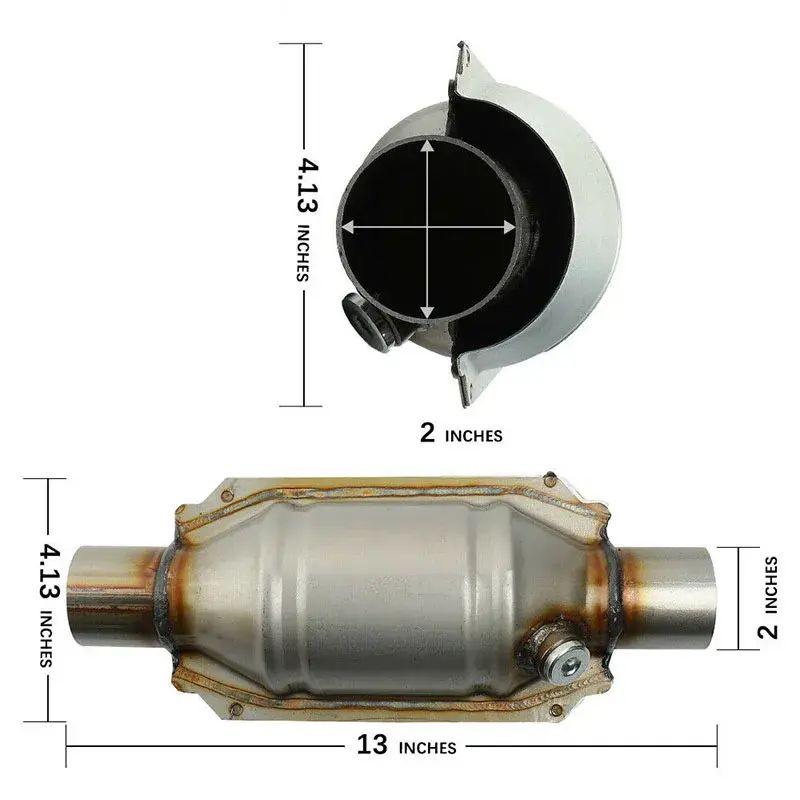
Material Evaluation: Core Types and Housing Durability
Housing construction determines long-term survival. Exhaust components endure brutal environmental conditions year-round. They face extreme heat cycles, flying road debris, and corrosive winter salt. You absolutely need a robust exterior shell to protect the internal substrate.
A high-quality stainless steel converter resists aggressive road corrosion. Manufacturers typically use 409 or 304-grade stainless steel for the outer body. The 304 variant offers superior rust resistance for harsh climates. The 409 variant handles rapid heat expansion slightly better, making it ideal for performance applications.
Internal substrate choices dictate your vehicle's performance ceilings. You generally choose between ceramic and metallic cores.
The traditional high flow ceramic converter remains highly popular among enthusiasts. It provides excellent emissions scrubbing capabilities. Ceramic retains heat well, helping the unit reach operating temperatures quickly. However, ceramic substrates are physically brittle. Severe impacts or vibrations can shatter them. Aggressive forced induction setups often destroy ceramic cores. Anti-lag systems generate explosive exhaust shockwaves. These shockwaves will crack a ceramic honeycomb instantly.
Metallic spun cores offer unmatched durability for extreme builds. They handle extreme Exhaust Gas Temperatures (EGTs) effortlessly. The metallic foil is incredibly thin. This thinness allows even higher flow rates than standard ceramic units. You will pay a premium price for metallic cores. Serious engine builders push high horsepower limits exclusively using metallic substrates.
Core Material Comparison Matrix
| Feature | Ceramic Core | Metallic Spun Core |
| Flow Rate Efficiency | High (Usually 200-400 CPSI) | Maximum (Usually 100-200 CPSI) |
| Heat Retention | Excellent (Fast warmup) | Moderate |
| Vibration Resistance | Low (Brittle under stress) | Very High |
| Ideal Application | Naturally aspirated, daily drivers | Turbocharged, track vehicles |
| Price Point | Budget-friendly | Premium |
Universal vs. Direct-Fit: Implementation & Cost Analysis
Cost efficiency drives many custom exhaust projects. OEM direct-fit replacements command massive upfront price tags. Dealerships apply heavy markups to factory emissions components. Universal units require significantly lower upfront investments. You skip the premium charged for exact-fit flanges, pre-bent pipes, and factory branding.
However, the word "universal" strictly implies custom fabrication. You cannot simply unbolt your old unit and bolt a universal one in. These components demand professional installation and metalworking skills. Consider the typical installation reality:
You must measure your existing exhaust pipe diameter accurately using digital calipers.
You need to cut out the defective factory component using a reciprocating saw or pipe cutter.
You must expand or reduce the universal inlet to match your stock piping precisely.
You have to TIG or MIG weld the seams flawlessly to create an airtight, leak-proof seal.
Oxygen (O2) sensor placement remains a critical fabrication step. Direct-fit units include pre-welded bungs in exact factory locations. Universal units often require custom bung installation. You must weld these sensor ports correctly. Always position them between the 10 o'clock and 2 o'clock angles on the pipe. This upward angling prevents internal exhaust condensation from pooling and ruining the sensitive probe. You must also maintain the correct factory distance between the upstream and downstream sensors.
Compliance, CEL Risks, and Emissions (The Trust Factors)
Check Engine Light (CEL) triggers scare many potential buyers away from exhaust upgrades. Modern engine computers monitor catalyst efficiency relentlessly. They constantly compare data from upstream and downstream O2 sensors. High-flow units process exhaust gases very quickly. Because of this speed, they sometimes fail to store enough oxygen to satisfy factory computer parameters.
This rapid flow triggers a P0420 or P0430 diagnostic code. The computer incorrectly assumes the catalyst is failing. Builders often mitigate this using hardware spacers or defoulers. These simple devices pull the sensor slightly out of the direct exhaust stream. Note, hardware spacers are strictly for off-road use where legally applicable. Software tuning provides the ultimate, most reliable solution. Professional tuners adjust sensor sensitivity thresholds directly within the engine computer.
Emissions regulations vary wildly depending on your location. You must understand the strict differences between EPA and CARB standards.
EPA Standards: Federal regulations allow aftermarket replacements on OBDII vehicles under strict criteria. The original unit must be missing, heavily damaged, or demonstrably failed. These compliant units are generally legal for 49-state use.
CARB Standards: California enforces brutal emissions laws. You cannot legally install standard aftermarket converters there. CARB requires specific Executive Order (E.O.) numbers. Manufacturers stamp these approved numbers directly onto the converter body.
Finally, high-flow units easily pass the classic "smell" test. Cat-delete pipes leave your clothing smelling heavily like raw fuel and sulfur. A properly sized high-flow core neutralizes unburned hydrocarbons effectively, keeping your exhaust smelling clean.
Decision Framework: How to Shortlist the Right Converter
Choosing the correct unit requires careful measuring and vehicle research. Sizing your piping correctly prevents creating new flow bottlenecks. Follow a simple fabrication rule of thumb. Match the inlet and outlet diameters exactly to your existing exhaust system. Do not step down a 3-inch performance system to a 2.5-inch converter. This creates massive turbulence.
Pay close attention to engine displacement capacity. Manufacturers rate converters by maximum engine size and Gross Vehicle Weight Rating (GVWR). You might find a compact converter rated for up to 3.0 liters. Installing this small unit on a heavy 5.9-liter V8 truck guarantees premature failure. The massive exhaust volume will overwhelm the small substrate. The core will overheat, melt, and eventually clog the exhaust pipe entirely.
Take clear action steps before making a final purchase. Measure your exhaust pipe outer diameter exactly. Research your specific state emissions laws online to determine EPA or CARB requirements. Finally, consult a local exhaust fabrication shop to discuss welding costs and sensor placement strategies.
Conclusion
A high-flow universal catalytic converter transforms your vehicle's driving dynamics. It serves as a highly effective upgrade for serious builders seeking optimized flow. You achieve superior exhaust velocity and vastly improved acoustic tones. However, you must account for custom welding requirements and respect local emissions laws.
Upgrading successfully recovers trapped horsepower. It deepens your exhaust note while actively preventing nasty cabin drone. Choosing the right core material ensures long-term durability. Metallic cores handle extreme track abuse, while ceramic cores provide cost-effective daily driving performance.
Ready to unleash better airflow and a deeper sound? Start by measuring your current exhaust piping. Browse available inventory by inlet size and material preference. If you feel unsure about displacement ratings, contact technical support teams for specialized sizing assistance today.
FAQ
Q: Do high-flow catalytic converters trigger a Check Engine Light?
A: Yes, they often can. Modern vehicles use sensitive downstream O2 sensors to monitor catalyst efficiency. High-flow units process exhaust gases much faster than restrictive factory units. This rapid flow can trick the sensor into reporting low efficiency, triggering a P0420 or P0430 code. Proper engine tuning easily resolves this sensor sensitivity issue.
Q: Is a universal catalytic converter street legal?
A: Legality depends entirely on your location. EPA-compliant converters are legal in 49 states for replacing failed factory units on OBDII vehicles. However, California requires strict CARB-compliant units. These units must feature a stamped Executive Order (E.O.) number. Always verify your specific local state laws before installation.
Q: How much horsepower does a high-flow cat actually add?
A: Expect realistic gains of 5 to 10 horsepower on a stock engine tune. The real benefits appear on heavily modified setups. Forced induction engines with custom tuning can see gains of 20+ horsepower. The converter recovers power lost to backpressure rather than creating new power.
Q: Can I clamp a universal converter instead of welding it?
A: We strongly advise against using exhaust clamps. Clamped connections on catalytic converters inevitably vibrate loose and cause exhaust leaks. These leaks disrupt O2 sensor readings and ruin exhaust sound. Professional TIG or MIG welding provides the only reliable, permanent, and airtight seal.


