Exhaust systems endure extreme conditions under your vehicle every day. They face constant thermal expansion, engine torque, and brutal road vibration. Without proper decoupling, these aggressive forces quickly cause structural fatigue. You will eventually see cracked manifolds and experience dangerous exhaust leaks inside the cabin. A high-quality auto exhaust flexible pipe absorbs these harsh stresses perfectly. It protects critical emission components and guarantees long-term system health. This guide completely deconstructs modern material grades, internal structural designs, and strict sizing criteria. We help procurement managers, repair facilities, and advanced DIYers select the correct part. You will learn how to secure the best fitment without overspending or sacrificing reliability.
Key Takeaways
Material Matters: 304-grade stainless steel offers superior corrosion resistance, while 409-grade is the industry baseline for cost-effective heat tolerance.
Internal Structure dictates lifespan: Double-braided and interlock designs prevent premature failure in high-pressure or heavy-duty applications compared to standard single-mesh pipes.
Fitment Reality: While universal slotted ends offer easier clamp-on installation, weld-on connections remain the standard for permanent, leak-free seals.
Sizing Precision: Accurate Inner Diameter (ID) and overall length measurements are non-negotiable for proper flow dynamics and system compliance.
Material Selection: Why the Right Stainless Steel Exhaust Pipe Matters
Businesses and mechanics need highly reliable parts for exhaust repairs. Standard aluminized steel degrades rapidly under intense heat. Environmental moisture destroys it very quickly. Upgrading materials changes this dynamic entirely. The business case for superior metallurgy becomes undeniable. Stronger metals ensure a long-term return on investment. They also minimize frustrating warranty claims from unhappy customers. You avoid repeating the exact same repair down the road.
The automotive industry relies heavily on 409-grade materials. Manufacturers consider it the ultimate baseline for cost-effective heat tolerance. It handles aggressive thermal cycling incredibly well. It expands and contracts predictably under the vehicle. However, you will notice surface rust over time. The lower chromium content allows light surface oxidation. We recommend 409 primarily for standard daily drivers operating in mild climates.
In contrast, 304-grade represents the premium upgrade. It contains significantly high levels of chromium and nickel. This unique metallurgical blend resists corrosion beautifully. Deep rust rarely forms on its smooth surface. Experienced mechanics choose it for harsh winter climates. Upgrading to a 304 stainless steel exhaust pipe prevents premature degradation. Highly acidic condensation and harsh road salts cannot destroy it easily. Commercial fleet operators save significant labor hours using these premium grades.
Material Grade Comparison Chart
| Feature | 409 Grade | 304 Grade |
| Corrosion Resistance | Moderate (Surface rust expected) | Excellent (Highly rust-resistant) |
| Heat Tolerance | Very High | Very High |
| Primary Application | Daily drivers, mild climates | Harsh winters, performance builds |
| Cost Profile | Cost-effective baseline | Premium investment |
Structural Engineering: Finding a Truly Durable Exhaust Pipe
Engineers design internal exhaust structures to manage specific gas velocities. You must carefully choose the right internal design for your application. Each structural type handles engine vibration and heat differently.
Single wire mesh designs are incredibly common in the aftermarket. They offer a highly flexible, cost-effective solution for simple repairs. Unfortunately, they remain highly susceptible to internal turbulence. Exhaust gases often whistle as they pass through the loose mesh. Mechanics usually reserve single mesh units strictly for low-budget passenger car repairs.
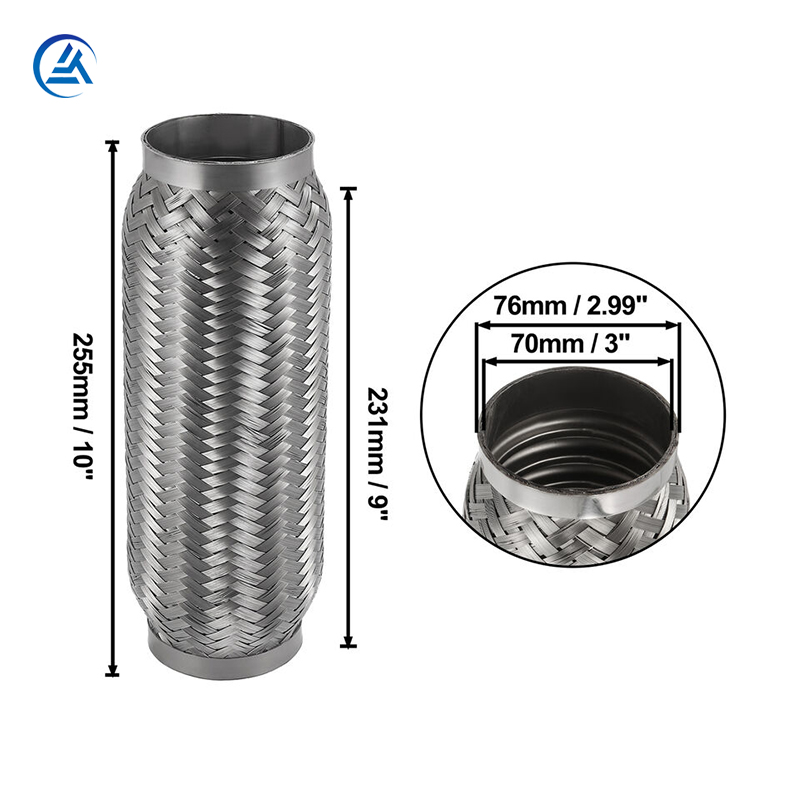
Heavy-duty applications require robust double-braided designs. These feature both inner and outer tightly woven wire meshes.
They significantly reduce intense system vibration.
They efficiently dampen annoying exhaust drone noise.
They successfully protect the internal corrugated bellows from high exhaust velocity degradation.
High-performance vehicles absolutely demand interlock designs. We often call these solid corrugated bellows. They feature a solid, spiral-wound inner liner. This specific geometry creates a remarkably smooth internal flow for fast-moving exhaust gases. Backpressure drops dramatically as a result. Turbocharged vehicles rely heavily on this precise internal design. Heavy-duty commercial applications also find this type of durable exhaust pipe essential for maintaining peak engine performance.
Sourcing Strategy: OEM Flexible Exhaust vs. Universal Replacements
Procurement teams constantly weigh factory replacements against aftermarket solutions. Factory parts come pre-welded to adjacent flanges or catalytic converters. The success criteria here revolve around repair speed. Technicians enjoy true plug-and-play installation every time. The flange bolts line up perfectly without any structural bending. You maintain guaranteed emissions compliance without any guesswork.
The primary trade-off is the much higher upfront cost. You often replace perfectly good piping just to fix a small broken flex joint. A simple OEM flexible exhaust assembly might require swapping an entire expensive catalytic converter section.
Universal aftermarket connectors flip this financial equation entirely. They remain highly cost-effective for budget-conscious drivers and independent repair shops. Technicians simply cut out the failed flex section. They only replace what is actually broken. You save hundreds of dollars on raw parts. Sadly, this approach requires extreme mechanical precision. Fabrication skills are absolutely mandatory for a successful repair. You must either weld the joints or use specialized clamping techniques.
Consider this shortlisting logic when sourcing components:
Assess the current vehicle warranty status before ordering.
Choose factory replacements for active warranty vehicles to ensure compliance.
Calculate total fabrication labor costs at your local repair shop.
Buy direct-fit OEM parts if fabrication labor exceeds the OEM part price.
Select universal connectors for targeted, budget-conscious, out-of-warranty repairs.
Installation Variables for Your Car Exhaust Connector
Installation techniques heavily dictate the final seal quality. The professional industry standard demands strong weld-on connections. A skilled technician uses TIG or MIG welding equipment. They create an airtight, permanent seal all the way around the pipe joint. This reliable method prevents all future exhaust leaks. It also ensures long-term structural rigidity. However, it requires significant expertise. You need expensive welding gear and safety equipment.
Alternatively, you can choose clamp-on methods for easier driveway repairs. Slotted ends feature pre-cut expansion slots on the extension tubes. They allow for overlapping slip-fitment over the existing pipe. You secure them tightly using heavy-duty U-bolts or wide stainless band clamps. Band clamps provide a superior 360-degree clamping force compared to basic U-bolts.
Implementation risks always exist during installation. Overtightening your clamps will inevitably crush the inner tubing. Crushed tubes lead directly to frustrating exhaust leaks. On the welding side, poor weld penetration leaves tiny pinhole gaps. These tiny leaks cause vehicles to fail strict state emission tests. They also trigger annoying oxygen sensor fault codes on your dashboard.
System compatibility remains your absolute top priority. You must guarantee the new car exhaust connector matches the exact Inner Diameter (ID) of the original pipe. Mismatched tube sizes create highly restrictive flow bottlenecks. Bottlenecks suffocate engine power and reduce fuel efficiency.
Evaluation Dimensions & Common Failure Points
Flexible decoupling components fail for three primary reasons in the real world. We must evaluate these dimensions carefully to prevent early failure.
Vibration fatigue happens incredibly frequently. Flex pipes handle minor engine roll during hard acceleration. They cannot support the actual physical weight of a sagging exhaust system. When rubber exhaust hangers break, the entire exhaust drops slightly. This transfers hundreds of pounds of downward force directly onto the flex joint. It tears the braided mesh apart in mere weeks. To prevent this, always inspect worn rubber exhaust hangers. Replace them immediately during every new flex pipe installation.
Bottoming out causes severe physical abrasion to the mesh. The flex section often sits at the absolute lowest point under the vehicle chassis. Speed bumps, steep driveways, and road debris strike it constantly. To prevent this physical damage, select double-braided outer meshes. They offer vastly superior physical abrasion resistance against road hazards.
Internal burnout destroys standard mesh pipes very quickly. Turbocharged applications generate extreme exhaust gas temperatures. Standard wire mesh burns, hardens, and unravels internally under these brutal heat conditions. To prevent thermal failure, always specify an interlock-lined flex pipe for all high-heat or forced-induction scenarios.
Conclusion
Selecting the correct decoupling component perfectly optimizes your vehicle's emission system. You must strictly align material grades and internal geometry directly to the actual driving environment.
Choose 409 stainless double-braided units for standard daily drivers to balance cost and reliability.
Invest in 304 stainless interlocked connectors for high-performance builds or harsh winter climates.
Measure existing pipe inner diameters meticulously before ordering any replacement parts.
Evaluate your personal shop capabilities honestly when deciding between advanced welding and simple clamping.
Source replacement components only from reputable manufacturers providing clear material grade certifications.
FAQ
Q: How do I measure an auto exhaust flexible pipe for replacement?
A: Measure the outside diameter (OD) of your existing exhaust pipe to determine the required inner diameter (ID) of the new flex pipe. Then, measure the length of the damaged flex section, adding 1 to 2 inches on each side if you plan to use a slip-over clamped connection.
Q: Can a flexible exhaust connector be clamped instead of welded?
A: Yes, provided the flex pipe features "slotted ends" or straight extensions designed to slip over the existing pipe. However, welding is strongly recommended for a permanent, leak-free seal, especially upstream of oxygen sensors.
Q: What is the difference between single braided and double braided flex pipes?
A: Single braided pipes only have an outer mesh protecting the inner corrugated tube. Double braided pipes feature an additional inner mesh liner, which protects the bellows from high-velocity exhaust gases, reduces noise, and significantly increases durability.
Q: How long should a stainless steel exhaust flex pipe last?
A: A high-quality 304 stainless steel flex pipe can last 5 to 10 years (or the lifetime of the vehicle), depending on driving conditions, road salt exposure, and the condition of the engine mounts (which dictate how much stress the pipe absorbs).


