A clogged exhaust filter halts vehicle operations instantly. It triggers immediate dashboard warnings. It causes severe vehicle downtime and failed emissions tests. Ignoring these warnings risks catastrophic engine damage over time. Modern engines rely heavily on unrestricted exhaust flow. Fleet managers and European vehicle owners face a frustrating daily dilemma. They must balance high dealership replacement costs against severe reliability risks. Cheap aftermarket alternatives flood the market today. Budget parts often fail prematurely during normal operation. Dealership parts stretch maintenance budgets too far. Finding a reliable middle ground remains essential.
This guide evaluates how you can select a high-quality replacement part. We explore how to meet strict European emissions standards without overspending. You will learn the technical differences between internal substrate materials. We examine exact-fit casing designs. We show you how to maintain vehicle uptime effectively. We provide clear steps to avoid persistent engine faults. Proper selection keeps your vehicles on the road longer.
Key Takeaways
OEM-quality filters utilize superior substrate materials (like Silicon Carbide) to withstand higher thermal stresses during active regeneration.
Installing an exact-match EURO 4 DPF or EURO 5 DPF prevents persistent Engine Control Unit (ECU) faults and backpressure issues.
Evaluating a durable diesel particulate filter requires looking beyond price to assess precious metal loading, direct-fit casing, and warranty terms.
Total Cost of Ownership (TCO) favors OEM-standard parts when factoring in the labor costs of premature aftermarket failures.
The business impact of sub-standard DPF replacements
Sub-standard replacements disrupt daily fleet operations constantly. A grounded vehicle costs you money every single hour. Recurring "limp mode" triggers plague cheap aftermarket filters. The engine management system detects poor exhaust flow immediately. It restricts engine power to protect internal components. Drivers cannot exceed basic speeds. They cannot climb hills effectively. You lose immense productivity when vehicles sit idle awaiting repairs.
We often see the false economy of low-tier aftermarket options. Budget filters look appealing initially on paper. However, they lack adequate thermal mass internally. Active regeneration cycles generate intense internal heat constantly. Exhaust temperatures spike dramatically to burn off trapped soot. Cheap substrates crack under this extreme stress. This structural failure requires another immediate replacement. You pay for installation labor twice. You lose vehicle availability twice. We strongly advise avoiding this trap.
Compliance risks present another major business threat today. Local emissions inspections grow stricter every year across Europe. Low-quality filters provide inadequate filtration efficiency overall. You will fail local MOT or TÜV inspections immediately. Authorities issue hefty fines for non-compliance. Commercial fleets risk losing operating licenses completely. Environmental regulations demand reliable particulate trapping. You cannot bypass these rigid legal requirements. Assess your risks carefully before buying cheap parts.
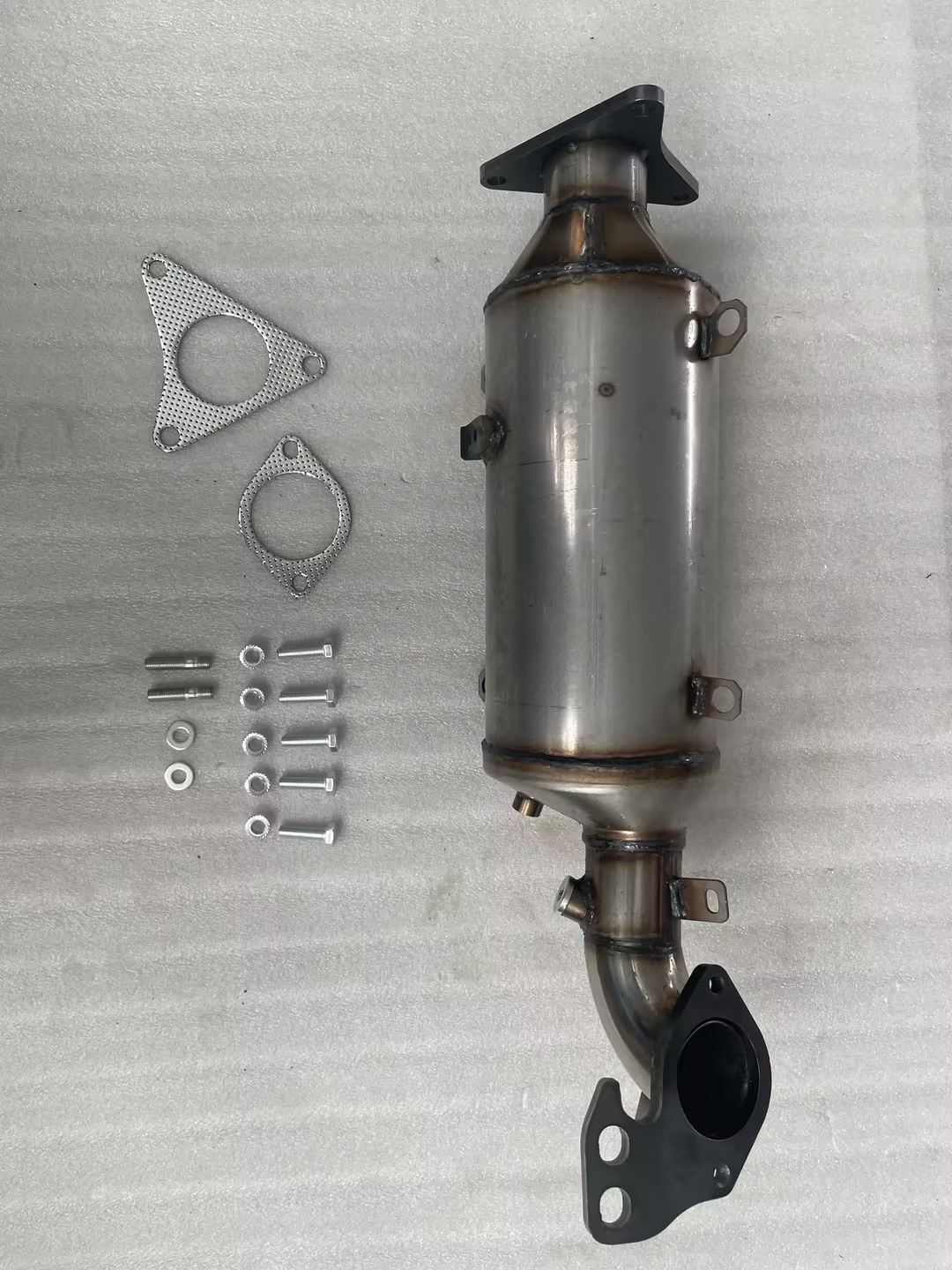
OEM DPF vs. Aftermarket: A structural evaluation
Understanding structural differences helps you make better purchasing decisions. A reliable OEM DPF relies on premium core materials. Substrate materials define filter longevity fundamentally. Cheap aftermarket filters usually use Cordierite cores. Cordierite melts at lower exhaust temperatures unfortunately. It handles standard driving well but fails during aggressive forced regeneration.
OEM applications for European cars use Silicon Carbide (SiC) exclusively. Volkswagen, Audi, and BMW rely on SiC substrates. Silicon Carbide handles intense heat effortlessly. It provides superior thermal stability under heavy loads. It conducts heat evenly across the entire core block.
Precious metal loading dictates regeneration capabilities directly. Platinum and palladium coat the internal substrate walls. These rare metals act as essential chemical catalysts. High volumes allow filters to burn off soot at lower temperatures. This process defines efficient passive regeneration. Budget options skimp heavily on these expensive metals. They rely entirely on forced active regeneration instead. This heavy reliance wastes fuel and stresses the engine.
Casing and canning quality prevent external physical failures. You need high-grade stainless steel outer casings. Automated robotic welding prevents dangerous exhaust leaks. It stops sensor thread stripping over time. Poor casing ruins an otherwise perfect internal substrate. We always recommend checking casing thickness before purchase.
Substrate Material Properties Comparison
| Material Type | Melting Point Threshold | Thermal Shock Resistance | Typical Application Category |
| Cordierite | Low to Medium | Moderate | Budget Aftermarket Units |
| Silicon Carbide (SiC) | Very High | Excellent | Premium European Vehicles |
Ensuring exact compliance: EURO 4 DPF and EURO 5 DPF standards
European regulations establish rigid environmental baselines. Particulate mass (PM) and particulate number (PN) define these firm boundaries. Euro 4 allowed slightly higher mass limits historically. Euro 5 introduced much tighter emissions thresholds. Installing a EURO 4 DPF on a newer engine causes immediate failures. The newer engine expects stricter filtration performance. You must match the generation perfectly. A genuine EURO 5 DPF contains denser substrate walls. It uses specific proprietary washcoat formulations.
ECU communication relies on exact flow rates. The computer monitors upstream and downstream pressures continuously. It uses sensitive differential pressure sensors. Incorrect flow rates trigger persistent check-engine lights. Wrong backpressure thresholds confuse these vital sensors. The system assumes your new filter is clogged. It initiates unnecessary regeneration cycles repeatedly. This continuous cycling dilutes engine oil dangerously. It damages internal engine bearings eventually.
European Emission Standards Limit Overview
| Euro Standard Phase | Implementation Year | Particulate Mass Limit (g/km) |
| Euro 4 Phase | 2005 | 0.025 |
| Euro 5 Phase | 2009 | 0.005 |
| Euro 6 Phase | 2014 | 0.0045 |
Selecting the correct standard for your fleet
You must identify your required standard accurately. Never guess the required emissions category blindly. Follow these strict verification guidelines:
Check the exact vehicle identification number (VIN) through official dealer portals.
Verify the specific engine code stamped directly on the engine block.
Review the vehicle homologation documents for official Euro class ratings.
Consult cross-reference databases provided by trusted exhaust suppliers.
Retrofitting incorrect categories causes immediate inspection failures. Inspectors analyze digital ECU logs alongside physical tailpipe emissions. You cannot cheat the modern digital diagnostics. Mismatched categories flag permanent unerasable codes.
Technical criteria for a durable diesel particulate filter
Evaluating a durable diesel particulate filter requires examining internal specifications. Cell density matters greatly for overall performance. Engineers measure this in cells-per-square-inch (CPSI). Typical units feature either 200 or 300 CPSI. Optimal density balances maximum soot trapping effectively. It maintains minimal acceptable exhaust backpressure. High CPSI catches more soot but restricts gas flow. Low CPSI flows well but lets dangerous soot escape. Premium filters optimize this delicate ratio precisely.
Thermal shock resistance determines operational lifespan strictly. Active regeneration creates rapid temperature spikes internally. Exhaust gases frequently exceed 600°C during this process. The internal core must survive these sudden shocks without degrading. Poor structural integrity leads to internal melting. Melted cores block exhaust flow completely. They require emergency towing and immediate replacement. We consider high thermal resistance non-negotiable.
Ash capacity dictates long-term maintenance intervals directly. Physical internal volume controls lifespan completely. Soot burns away entirely during regeneration. Incombustible ash remains behind permanently. This heavy ash accumulates slowly over thousands of miles. It eventually necessitates physical manual cleaning. Sometimes it requires secondary part replacement. Larger internal volumes store more ash safely. They extend your maintenance intervals significantly. You gain thousands of extra driving miles.
Implementation realities: Installation and ECU calibration
Physical installation demands direct-fit geometry. Precise flange alignments eliminate installation headaches completely. Sensor port angles must match factory positions perfectly. Exact hanger brackets eliminate custom modification labor. Technicians waste hours wrestling poor-fitting parts into place. They risk snapping fragile exhaust sensors accidentally. High-quality replacements bolt on seamlessly. They save expensive shop labor hours. They fit exactly like the original factory component.
We highly recommend following these standard installation sequences:
Inspect all surrounding exhaust clamps and flexible pipes for hidden stress damage.
Replace all joining gaskets to ensure completely airtight seals everywhere.
Torque all delicate sensor fittings to exact factory specifications carefully.
Verify adequate clearance around heat shields and surrounding underbody components.
Post-installation software requirements demand specialized diagnostic tools. Physical installation is only step one. Resetting learned ECU values remains mandatory. You must clear the internal soot mass counters completely. The engine needs a clean digital baseline. It uses this baseline to calculate future soot accumulations accurately. Skipping this step ruins the new filter. The computer will force unnecessary regenerations immediately.
Forced regeneration testing completes the job properly. We recommend a mandatory diagnostic drive cycle post-install. Technicians must verify differential pressure sensor readings live. They must confirm active regeneration capability before returning vehicles to service. Ensure exhaust temperatures reach proper burning thresholds. Verify pressure drops across the substrate match expectations. Quality diesel particulate filter replacements require this complete holistic approach.
Conclusion
We must summarize the essential decision framework clearly. Always prioritize superior substrate materials over initial purchase price. Demand adequate precious metal loading internally. Ensure exact Euro-standard compliance for your specific engine code. Do not compromise on casing quality or external weld integrity. Treat your purchase as a long-term operational investment.
High-quality replacements represent vital investments. They ensure maximum vehicle uptime reliably. They guarantee strict regulatory compliance locally. They protect your expensive engine components from excessive exhaust backpressure. Choosing correct parts eliminates recurring dashboard warnings. It stops endless frustrating workshop visits. It keeps your commercial fleet running smoothly.
Take action before initiating any purchase. Verify your exact factory part numbers. Check them against supplier cross-reference databases carefully. Consult digital diagnostic logs to confirm the root cause of past failures. Secure your fleet's reliability and compliance today. Make informed technical decisions every time.
FAQ
Q: How long should an OEM-quality diesel particulate filter last?
A: A premium replacement typically lasts between 80,000 to 120,000 miles. This lifespan remains highly contingent on your specific driving conditions. Highway driving extends longevity significantly. Stop-and-go city traffic shortens it. Maintaining optimal engine health and using low-ash oil prevents premature ash accumulation.
Q: Will an aftermarket DPF void my European vehicle's warranty?
A: No, it will not. European Block Exemption Regulations protect consumers. Using matching quality parts does not void the manufacturer warranty. You must ensure the replacement meets exact factory specifications. Keep all purchase receipts and installation records to prove compliance during warranty claims.
Q: Why does my new DPF require an ECU reset?
A: The engine management system adapts to your old, clogged filter. It learns those high-pressure values. You must reset the ECU to establish a new, zero-backpressure baseline. This reset allows the computer to calculate future soot accumulation accurately. Skipping this step triggers unnecessary, damaging regeneration cycles.
Q: What is the difference between a EURO 4 and EURO 5 DPF?
A: They differ primarily in internal substrate density. Euro 5 limits are significantly stricter. A Euro 5 unit requires advanced washcoat formulations. It uses denser cell structures to trap finer particulate mass. You cannot interchange them without causing severe ECU communication errors and immediate emissions test failures.


