Modern exhaust system design faces a persistent friction point. Engineers must constantly balance stringent global emission compliance against the ongoing demand for maximum engine performance. Traditional catalytic converters often choke high-performance engines. They restrict gas flow, increase internal temperatures, and rob horsepower. We solve this bottleneck by turning to the metal honeycomb catalyst carrier. It serves as the ultimate mechanical foundation for high-flow, high-stress exhaust applications.
Automotive engineers, performance tuning manufacturers, and industrial fleet operators constantly evaluate substrate upgrades. Finding the perfect equilibrium requires meticulous planning. Upgrading your exhaust infrastructure is rarely simple. It demands a deep understanding of thermodynamics, gas velocity, and structural integrity. You cannot simply install an empty pipe and remain road-legal.
In this comprehensive guide, you will discover how to properly specify metallic substrates for demanding environments. We cover cell density selection, critical material compositions, and advanced system integration strategies. This knowledge ensures your next exhaust build passes strict emission standards while sustaining absolute peak power output.
Key Takeaways
Performance vs. Compliance: Upgrading to a metallic catalyst carrier significantly reduces exhaust backpressure, safely accommodating high-horsepower outputs without triggering emission faults.
Structural Superiority: Metallic substrates tolerate higher thermal shock and mechanical vibration compared to standard ceramics, reducing premature core failure.
Precision Specification: Selecting the correct CPSI (Cells Per Square Inch)—typically 200 to 300-cell for high flow—is critical to balancing gas velocity with sufficient washcoat surface area.
System Integration: Proper canning and welding of the metal core into the broader exhaust emission system dictates the lifespan and reliability of the converter.
Evaluating the Engineering Case for a Metal Substrate Catalyst
High-density ceramic substrates create massive exhaust bottlenecks. They act like physical walls inside your piping. Traditional converters use dense, restrictive grid patterns to maximize chemical contact time. This restriction slows down exhaust pulses. Your engine works much harder to push spent gases out of the combustion chamber. This creates a parasitic power loss. It severely handicaps high-performance builds and heavy-duty diesel applications.
A successful carrier upgrade relies on strict performance criteria. You want a measurable reduction in your exhaust gas temperature (EGT). High EGTs melt inferior components and increase engine detonation risks. You must also preserve peak horsepower. Finally, you still need to pass baseline emission sniffer tests. Achieving all three goals requires superior engineering.
The secret to surviving these extreme conditions lies in foil material composition. Industry experts rely heavily on FeCrAl (Iron-Chromium-Aluminum) alloys. We use FeCrAl because it offers unmatched oxidation resistance. These specialized alloys easily survive continuous operating temperatures exceeding 1000°C. Standard materials simply disintegrate under similar thermal loads.
You will see the metal substrate catalyst deployed across three primary use cases. Motorsport teams use them to maximize track performance under extreme loads. Aftermarket tuners build them into premium performance exhaust systems. Heavy-duty industrial machinery relies on them to guarantee continuous, reliable operation in harsh environments.
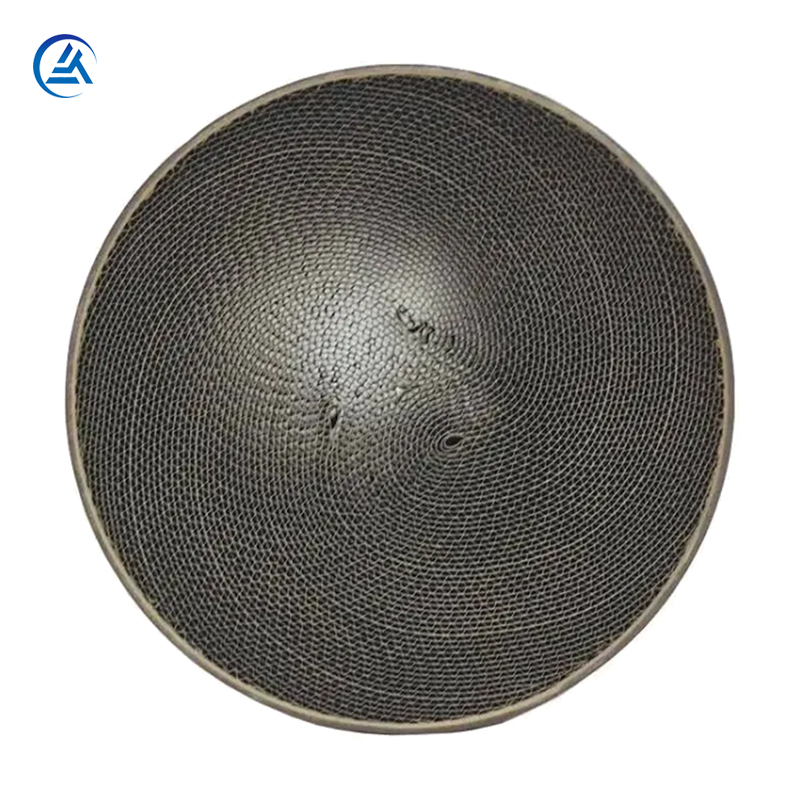
Metallic Catalyst Carrier vs. Ceramic: A Comparative Framework
Wall thickness directly dictates exhaust flow capability. Metal foil is incredibly thin. Manufacturers typically roll it to a thickness of 0.04mm to 0.05mm. Ceramic walls are significantly thicker and bulkier. This physical difference grants metal substrates a 15% to 25% higher Open Frontal Area (OFA). More open area means less physical restriction. Gases flow freely, improving overall engine volumetric efficiency.
Thermal conductivity plays a critical role in emission control. Metal heats up rapidly. It conducts thermal energy much better than porous ceramic. This allows the converter to reach its optimal operating temperature sooner. We call this the light-off phase. Faster light-off drastically reduces cold-start emissions. It keeps your vehicle compliant during those crucial first two minutes of engine operation.
Mechanical durability sets the metallic catalyst carrier apart from older technologies. Road debris constantly strikes underslung exhaust pipes. Extreme engine vibrations shake components loose. Rapid temperature fluctuations cause severe thermal shock. Imagine driving through a deep puddle with red-hot exhaust pipes. Sudden cooling shatters brittle ceramic units instantly. Metal actively prevents this "core shattering" phenomenon. It expands and contracts safely.
Lifecycle durability heavily favors metallic options. Metal substrates require a larger upfront investment. However, you justify this through a dramatically decreased replacement frequency. High-stress environments destroy standard factory units quickly. You avoid constant maintenance downtime by choosing a rugged metallic core. They survive longer, function better, and withstand severe abuse.
Comparative Framework Table
| Feature/Metric | Metallic Catalyst Carrier | Traditional Ceramic Carrier |
| Wall Thickness | 0.04mm – 0.05mm (Ultra-thin) | 0.10mm – 0.17mm (Thicker) |
| Open Frontal Area (OFA) | High (Often 85%+ open area) | Lower (Restrictive to gas flow) |
| Thermal Shock Resistance | Excellent (Expands/contracts safely) | Poor (Prone to shattering) |
| Light-Off Time | Fast (Heats up quickly) | Slow (Requires longer warm-up) |
| Vibration Tolerance | Superior (Welded structural integrity) | Low (Matting degrades over time) |
Specifying Cell Density: Flow Dynamics vs. Conversion Efficiency
You must select the correct cell density for your specific application. We measure this using CPSI, which stands for Cells Per Square Inch. CPSI serves as the primary metric for substrate selection. You must balance gas velocity against reactive surface area. Selecting the wrong density ruins engine performance. It also guarantees immediate emission test failures.
Engineers typically categorize flow applications into clear tiers. We evaluate them based on street legality and performance targets.
100 to 200 CPSI (Maximum Flow Tier): These cores provide the absolute lowest restriction. They are optimal for track-only or heavily modified motorsport applications. Gases pass through instantly. However, you face a high risk of failing standard street emission tests. The internal reactive surface area is simply too small to clean the exhaust gas thoroughly.
300 to 400 CPSI (High-Flow Street Standard): This represents the industry sweet spot. Most aftermarket manufacturers use this density for 2.5-inch or 3-inch exhaust piping. It balances a measurable backpressure reduction with sufficient washcoat retention. You gain horsepower while maintaining legal compliance.
600+ CPSI (OEM Replacement Standard): Highly restrictive factory units. They prioritize maximum chemical scrubbing over engine performance. We generally replace these during performance upgrades.
Lower cell density creates a strict washcoat trade-off. Gases spend far less time touching the catalytic walls. This chemical reality requires a highly optimized precious metal loading strategy. Manufacturers must adjust the Platinum (Pt), Palladium (Pd), and Rhodium (Rh) mixtures perfectly. You need higher chemical efficiency to execute the catalytic reaction during a shorter transit time. Poor washcoat formulations on low-CPSI cores result in persistent engine warning lights.
Integration within the Exhaust Emission System and DPF Substrate Applications
You cannot simply drop a metal core into an empty pipe. Proper integration dictates system reliability. Mounting a metal core carries specific implementation risks. Canning and welding require extreme precision. You must braze the internal matrix directly to the outer steel mantle. High exhaust velocities create immense pushing forces inside the housing.
Without structural vacuum-brazing, the inner foil pushes outward under pressure. We call this structural failure "core telescoping." Telescoping destroys the internal matrix instantly. Poor manufacturing techniques guarantee premature failure. Always verify how the factory secures the metal foil to the outer shell.
Consider the synergy within the broader exhaust emission system. Diesel applications present unique challenges. Engineers often pair oxidation catalysts with diesel particulate filters. Installing a metal carrier upstream of a DPF substrate offers massive operational advantages. The metal core lights off rapidly, generating early heat. This early heat transfer directly aids passive DPF regeneration cycles. It burns off trapped soot continuously, preventing filter clogging.
Finally, you must plan your sensor placements carefully. Custom carrier lengths alter exhaust gas flow profiles. Modified dynamics can easily disrupt downstream O2 sensor readings. Disrupted sensor data triggers persistent Check Engine Lights (CEL). Your engine control unit (ECU) requires stable, predictable gas readings. Ensure your new housing dimensions maintain spatial compatibility with factory sensor bungs.
Substrate Integration Chart
| Integration Aspect | Best Practice | Common Mistake to Avoid |
| Core Canning | Vacuum-brazing the matrix to the mantle | Friction-fitting or weak tack welds |
| DPF Pairing | Placing metal catalyst directly upstream | Placing it too far downstream, losing heat |
| O2 Sensor Placement | Maintaining factory distance from core exit | Placing the bung inside turbulent flow zones |
Procurement and Supplier Shortlisting Risks
Sourcing reliable components requires strict vendor vetting. Factory capabilities matter far more than slick marketing claims. You must demand documented proof of quality before placing bulk orders. Always look for ISO/TS 16949 certification. Ask your supplier for traceability logs regarding their raw FeCrAl materials. Cheap metal alloys degrade rapidly, leading to catastrophic core melting.
The primary failure point of cheap metal carriers is washcoat flaking. The naturally smooth metal surface struggles to hold chemical layers. Thermal expansion and contraction pop the coating right off the foil. Evaluate how suppliers handle their surface treatments. Reliable vendors apply specialized aluminum oxide primer layers first. They grow microscopic oxidation "whiskers" on the metal surface. These whiskers grab the primer tightly. This process guarantees long-term coating stability.
Assess your supplier’s customization flexibility. Every exhaust layout presents unique packaging constraints. You need a partner who adapts to your specific engineering limits.
Dimensional Precision: Can they manufacture custom diameters and exact lengths without minimum order penalties?
Non-Standard Shapes: Do they offer oval, racetrack, or asymmetrical housings for tight undercarriage spaces?
Variable Cell Densities: Can they blend different CPSI specifications to tune flow characteristics accurately?
Thoroughly vetting these capabilities separates successful product launches from costly recalls. Never accept standard catalog sizes if they compromise your exhaust geometry.
Conclusion
Transitioning to a metal honeycomb catalyst carrier represents a calculated engineering compromise. It heavily favors long-term durability and unrestricted gas flow over standard factory limitations. You eliminate the parasitic backpressure choking your engine while maintaining structural integrity under immense thermal loads.
Specific project constraints must always dictate your final specifications. Your target horsepower, vehicle weight class, and local emission laws shape the optimal CPSI. They also define your exact dimension requirements. Guessing these parameters leads to poor engine performance or failed compliance tests.
We encourage procurement managers and lead engineers to act proactively. Request a technical consultation before finalizing your exhaust designs. Submit your CAD drawings to substrate manufacturers for expert review. Order sample metallic substrates and run comprehensive flow-bench testing. Real-world validation proves the undeniable performance gains of metallic cores.
FAQ
Q: Can a high-flow metal catalyst carrier pass strict emission standards (e.g., Euro 6 or EPA)?
A: Yes, but it depends heavily on the precious metal loading (washcoat formulation) and selecting a balanced CPSI (usually 300-400). It is not guaranteed by the metal substrate alone.
Q: Why does washcoat sometimes peel off metallic carriers?
A: Metal has a smoother surface than porous ceramic. If the manufacturer does not properly oxidize or chemically treat the metal foil prior to coating, thermal cycling will cause the washcoat to detach.
Q: What is the maximum operating temperature for a metal honeycomb substrate?
A: High-quality FeCrAl alloy carriers can typically withstand sustained temperatures up to 1200°C, making them highly suitable for forced-induction (turbocharged) applications.
Q: Is it harder to weld a metallic core compared to canning a ceramic one?
A: Metallic cores must be vacuum-brazed or structurally pinned to the outer steel shell. Poor manufacturing here leads to "telescoping," where the inner foil pushes out of the housing under exhaust pressure.


